Dual-use drone targets crop spraying and emergency medical delivery
A paper from Brahmdevdada Mane Institute of Technology describes a low-cost quadcopter built to switch between precision agricultural spraying and urgent payload drops.
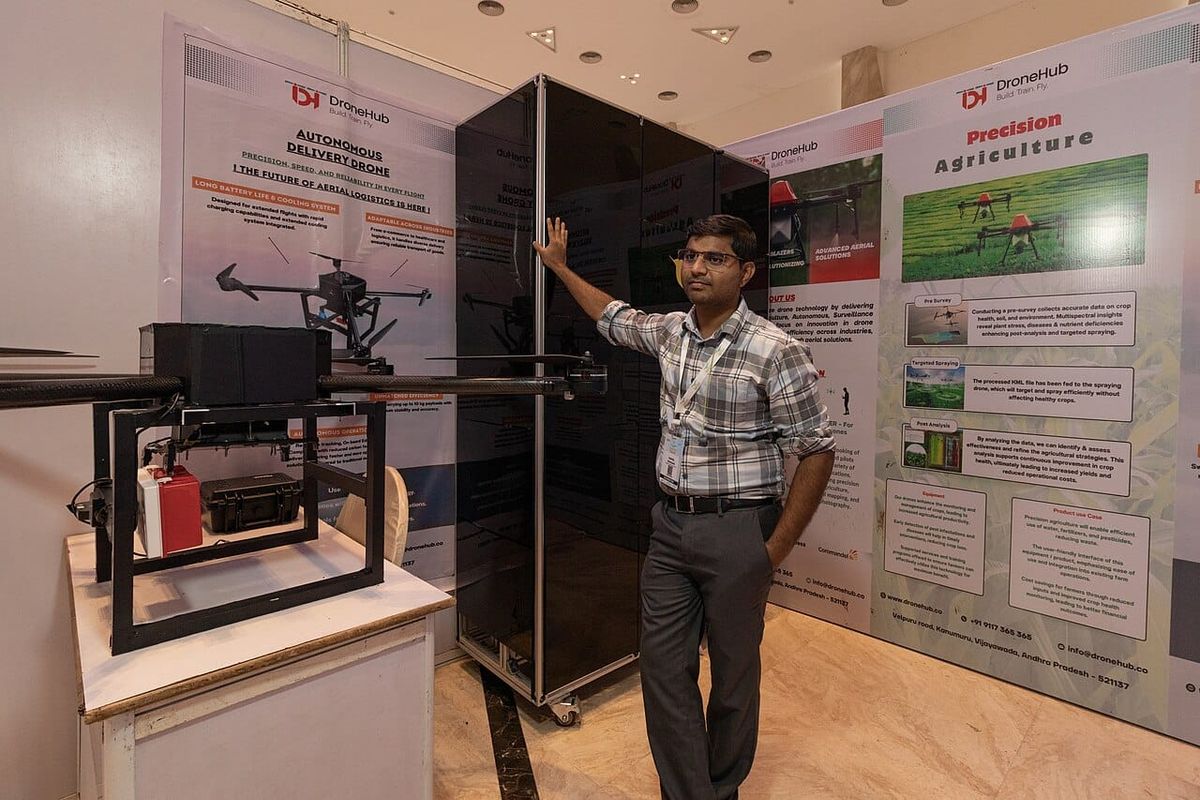
A multipurpose quadcopter designed for two jobs - targeted agricultural liquid spraying and rapid emergency delivery - is described in a paper from Brahmdevdada Mane Institute of Technology, Solapur, Maharashtra. The authors present it as a low-cost, high-efficiency platform.
The design is built around an F450 glass fiber/composite frame chassis carrying four 1500KV brushless DC outrunner motors, each rated at 1500 RPM per volt, paired with 30A electronic speed controllers. According to the paper, propulsion uses a high-discharge 3S/4S lithium polymer battery pack delivering an 11.1V-14.8V constant supply. The multirotor platform is organised into four functional modules: the structural frame, the electronic propulsion system, flight control and stability sensors, and radio communication.
Flight control is handled by a Cross Flight Controller equipped with integrated multi-axis gyroscopes, accelerometer sensors and auto-leveling PID loops for orientation holding. The paper describes the radio link as a FlySky FS-i6 6-channel 2.4GHz transmitter with dual antennas, matched to an FS-i6B PPM/i-BUS receiver using the AFHDS 2A protocol. Propellers are 8x4.5 or 10x4.5 carbon composite.
The authors state that experimental evaluation confirms flight stability, payload capacity, operational range and response time, and that the drone provides a reliable alternative for rural farmers and medical first responders. They frame the work against two stated problems: conventional agricultural spraying methods that often suffer from excessive pesticide waste, ground-level exposure hazards and slow coverage over rough terrain, and the hurdles rural healthcare facilities and disaster response teams face in delivering urgent medical supplies such as vaccines, antivenoms and first-aid packs. The paper says the drone is tailored for small-scale agricultural farms and remote medical outreach.
The authors report that spray duty and medical payload duty place different demands on payload capacity, range and response time, and take their evaluation of those parameters as confirming the design. Their findings are their own reported assessment.
Source: ijarsct.co.in, 31 October 2026.