Sami Robotics Says Its Multi-Arm Harvester Reached Commercial Produce, But the Capacity Figure a Grower Would Need Is Still Missing
The company says SAMI has moved beyond prototype onto commercial produce. Sami Robotics has not published a throughput figure a grower could use to model payback against a harvest crew, and its own caveat says performance depends on crop density, maturity distribution and field conditions.
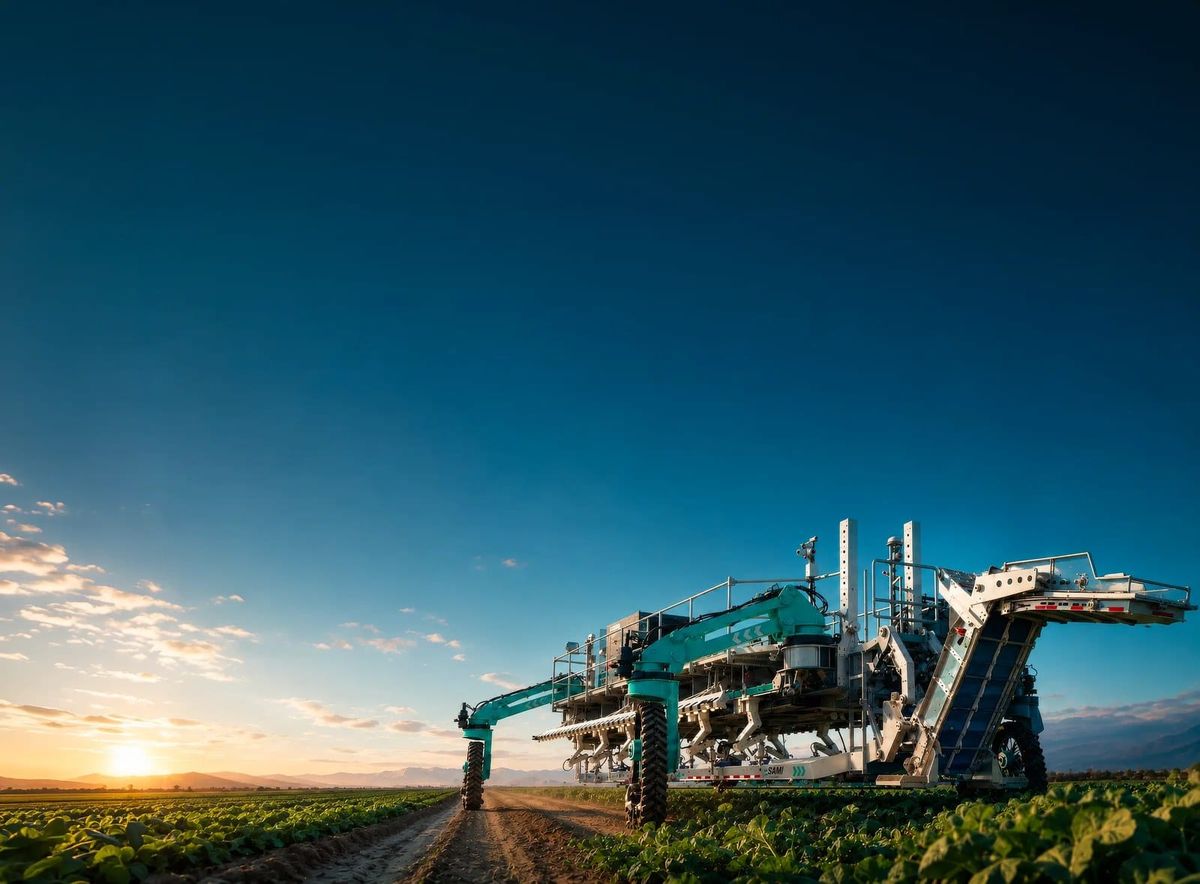
A grower weighing a multi-arm harvester against a harvest crew needs a throughput figure: heads per hour across a real field, across a maturity spread, across a week of weather. Sami Robotics has not published that figure. The company says its SAMI harvester has moved from prototype onto commercial produce. A grower can check the configuration today. The capacity is the input a procurement decision needs, and it is the figure that has not been published.
What the company claims
Sami Robotics says SAMI carries robotic arms working in parallel, with machine vision identifying harvest-ready heads, per the company's own material. Arm count sets a theoretical ceiling. The company's figure of 12 to 18 arms describes a machine configuration. Sami Robotics states that each arm can pick a ripe vegetable in under three seconds, and that figure appears in the company's material and is repeated elsewhere. That repetition is not independent verification: the figures share a single vendor origin.
The company also says the platform can be customised to specific crops and field conditions, and that performance varies with crop density and maturity distribution, according to a deployment summary. Read that caveat literally. The same hardware behaves differently in a dense block and a thin one, in a tight maturity window and a wide one. Two growers twenty kilometres apart, with different varieties and different planting schedules, could get materially different results from the same machine.
Why the missing number matters
The crop does not mature uniformly. A field on any given morning holds heads at different stages of readiness, and a hand crew handles that spread by selecting at the point of cut. A selective machine must reproduce that selection with vision, at speed, without bruising what it touches and without leaving marketable heads in the row. Those are requirements the machine must meet. Sami Robotics has not published a test result confirming SAMI meets them. Broccoli is the nearer target. Romaine is a crop still cut almost entirely by hand (romaine harvest coverage), which makes it both the larger prize and the harder selection problem.
What is claimed, and by whom, matters here. The claim that SAMI is beyond prototype and used on commercial produce comes from the company and from trade coverage that repeats it, including HortiDaily's report on the machine moving closer to commercial broccoli harvesting. Sami Robotics has not published a throughput figure for SAMI. That leaves the buyer relying on a vendor who has chosen not to publish a capacity number.
The strongest counterargument runs the other way. A grower does not have to underwrite a purchase on a published figure. A paid trial block, priced against the value of the crop cleared, plus a supplier performance guarantee written to a measurable heads-per-hour floor, would give the buyer the risk transfer a datasheet never does. Vendor figures are also rarely the basis on which growers actually buy; a neighbour who ran the machine through a peak week is worth more than a capacity sheet. On that view, the missing figure is a marketing gap. That argument is only half available here. Sami Robotics has not published a paid trial, a guarantee or a named grower, so the alternative path is available in principle and unconfirmed in this case. A real performance guarantee matters because the company uses the technology to absorb its own risk, and a grower who negotiates the trial properly absorbs the same risk as before.
What has been publicly associated with SAMI
Sami Robotics says SAMI was unveiled outside San Juan Bautista in California. A Western Growers-sponsored residency placed the machine at Reservoir Farms in Salinas, where it was run against commercial crops during the 2025 season, as reported by HortiDaily. Interesting Engineering also reports commercial-season work in Quebec. Sami Robotics has not named a commercial broccoli or romaine grower with a checkable operation, so a buyer cannot yet check the deployment against a comparable operation.
The gaps extend beyond that. Sami Robotics has not published a throughput figure tied to stated crop and field conditions, so a buyer cannot model payback against a harvest crew. It has not published pricing, lease terms or a service model, so a buyer cannot compare the machine against the labour it replaces. Its material does not specify whether the commercial-produce use means a full commercial field harvest, a paid trial block or a demonstration staged on a commercial farm. None of this contradicts the company's claims. It is the boundary of what the claims can currently support, and the boundary is where adoption decisions live.
Sami Robotics has not named a South African deployment, importer or grower. The relevance to South African vegetable growers is a structural inference: the crops are hand-harvested today, so the labour economics are comparable, but there is no documented local case.
A conditional operating picture is still worth drawing, because the constraints are predictable even where the numbers are not. Where a grower runs block-planted broccoli on a schedule that concentrates maturity into a few days, a multi-arm platform competes against a labour peak instead of against average labour cost. The peak is where the money actually goes, because that is when crews are scarcest and rates are highest. Where maturity spreads wide, the machine spends more passes chasing fewer ready heads, and the cost per harvested head rises. Where field conditions turn the ground soft or the rows uneven, the whole calculation can move again.
The tougher question is whether a machine that depends on vision, calibration and field uniformity can be kept running through a harvest window by the labour actually available, with spares and service reachable inside the period when the crop is ready. A machine that needs a specialist on site during a two-week harvest window has a different risk profile from one that runs with a field operator and a phone. That question is unanswered, and it matters more than the arm count.
The reading the claims support
A multi-arm platform has moved from prototype to commercial-produce use, according to the company, and that is genuine progress worth recording. It does not yet amount to a machine a grower can underwrite, because underwriting requires a capacity figure tied to stated crop and field conditions, and Sami Robotics has not published one. The company's caveat, that performance depends on crop density and maturity distribution and field conditions, is the right engineering answer. It is not a procurement answer.
The thing to watch is specific: a throughput figure with the crop, density and maturity conditions attached, produced by someone who does not work for the company. A named deployment, with grower and location a third party can check, is the second. And lettuce is the third, specifically whether romaine moves from a described capability to a repeated field operation. Until the first of those appears, the honest reading is that SAMI's capability is claimed and consistent, and its capacity is unknown.