Odd.Bot Says Its Weeder Is Working Dutch Fields. The Cost Per Hectare Is Not Published.
A vendor claim of commercial deployment, a design that grabs rather than cuts, and four numbers a grower would need to price the machine against a herbicide programme — none of which appear in the public record.
Odd.Bot says its Maverick weeder is in commercial operation on Dutch fields. A grower who wants to price it against a herbicide programme or a hand-weeding crew cannot do so with the public record, because the numbers that would let him run the arithmetic are not published.
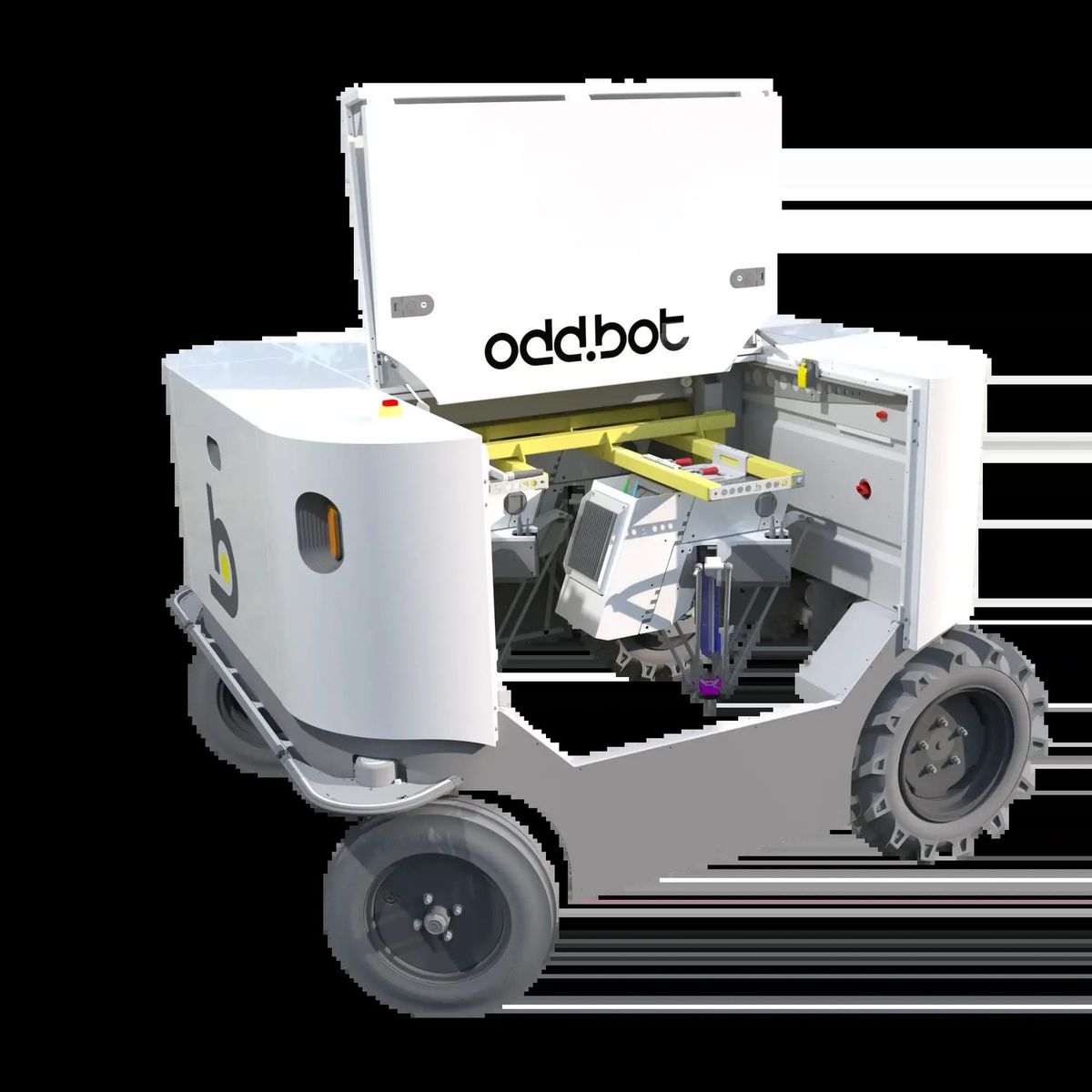
The Maverick is an autonomous, battery-electric field robot for mechanical weed control, using AI-based crop recognition, cameras and two delta arms. By the company's own account it identifies weeds with those cameras and an AI model, then removes them with the delta arms and a grabbing mechanism underneath, without chemical or operator input. It is aimed at arable and vegetable growers.
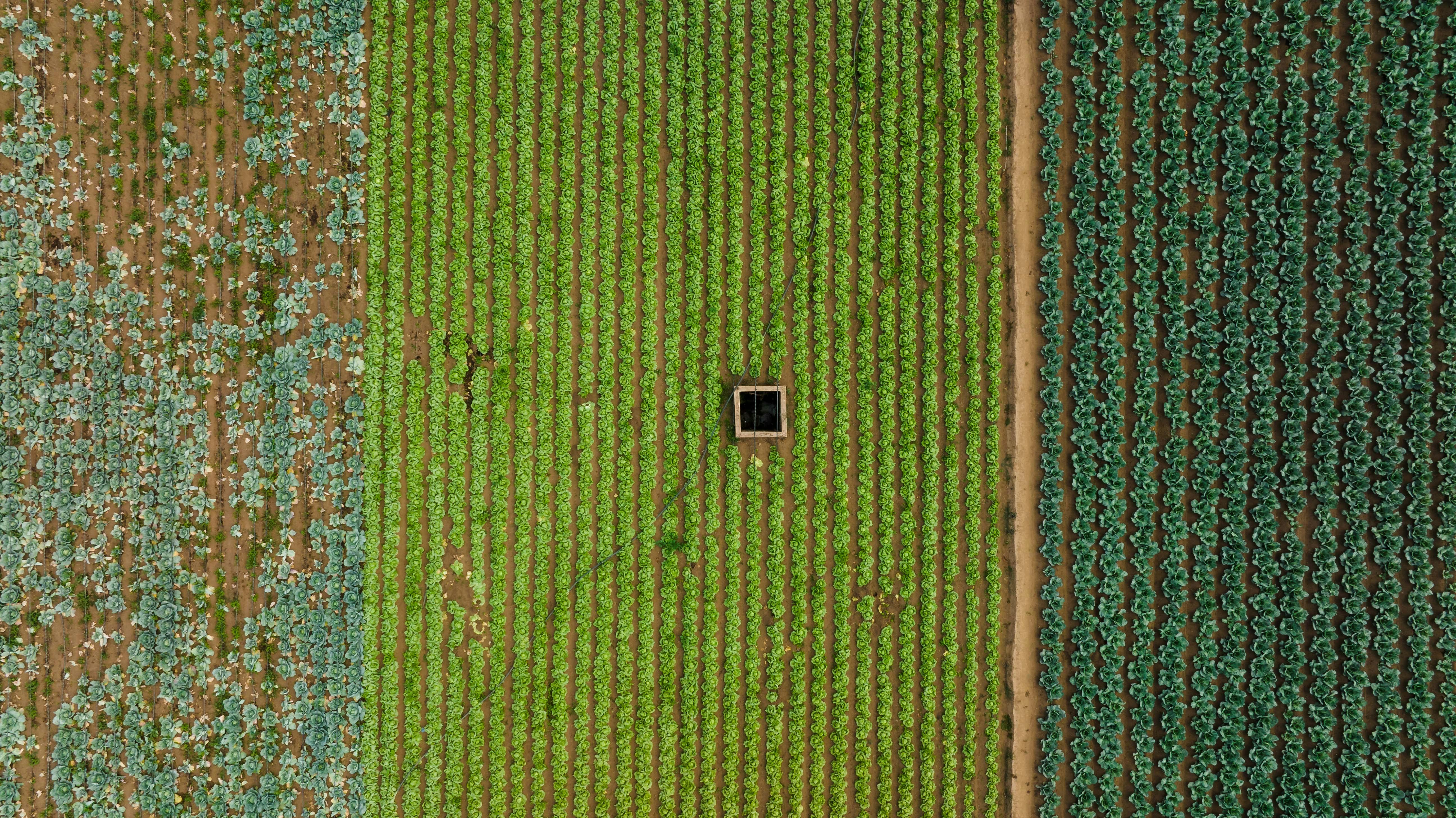
In 2025, the Maverick is operating on dozens of fields across the Netherlands, says Odd.Bot's Martijn Lukaart in a company blog post. That deployment line is the company's own assertion, repeated only in Odd.Bot's own material. Treat "dozens of fields across the Netherlands" as a directional vendor claim. No named farm and no measured trial report in the public record confirms it.
A vendor figure is not a mechanism
Odd.Bot's product page publishes a 240,000-weeds-per-hectare figure. Reseller listings repeat the same number. It is a vendor figure: published by the company, republished by others, with no method statement attached. The same provenance covers the ~2 mm precision figure carried in a reseller listing, and no measured false-positive rate is published.
The design choice that carries consequences onto a field is the delta arms with a mechanism underneath, documented in detail. The arms remove the plant from the soil rather than severing it at the stem, which is the mechanical difference from cutting. Grabbing is also the hardest variant of mechanical weeding to build, because it requires per-plant localisation accurate enough that the gripper closes on the weed and not the crop, and a stroke rate that makes the pass economical.
That reasoning is the author's, drawn from the design rather than the record, and it points to an operating question a buyer should test rather than a mechanism the article has established. A grabbing robot's pass rate is set by how many strokes per second the arms can reliably achieve, which in turn depends on whether the vision model reliably separates a two-leaf weed from a two-leaf crop seedling under field lighting, at the growth stage where a herbicide pass would normally go on. Get that classification wrong at speed and the machine's failure mode shifts toward missed weeds or crop damage. Millimetre positioning at the tool head is a mechanical specification; whether the system can correctly classify a two-leaf weed from a two-leaf crop seedling in a weedy field is a vision and model problem, and no evidence item addresses it. Both of these are hypotheses for a buyer to test on his own ground, not findings.
The missing number, and why it caps the others
A weeding robot that works and a weeding robot that makes a farm money are two different objects, and the evidence only speaks to the first.
Pricing a Maverick against a herbicide programme or a hand-weeding crew requires four numbers: hectares per hour, hours per day the machine can work under Dutch weather, weed removal rate under real pressure, and cost per hectare. None of the four appears in the public record. Price itself is absent from the product page, and no lease structure appears in the FAQ. The only economic statement supportable from the evidence is directional: a capital machine substitutes for chemical and labour inputs.
Of the four, the runtime is the number a Maverick buyer should demand first, because it is the input the others depend on. A battery-electric platform that identifies and mechanically removes individual weeds is doing a lot of work per metre, and Odd.Bot does not publish a runtime figure in the material gathered here. If the machine can only work a fraction of the day, the grower's weeding window compresses, hectares per hour falls toward the effective, and cost per hectare rises in a way the sticker price does not show. A grower's decision rule follows: a published duty cycle that covers the crop's critical weeding window makes the machine worth pricing against the current programme; a duty cycle that does not, does not, regardless of how capable the gripper is.
Odd.Bot has been at it since 2018. The company says the machine is past market entry and already working on fields. Those two statements are the whole of the commercial record gathered here: no funding, revenue, unit-sales or certification detail appears in the material, and the only operational claim is the company's own. On the manufacturing side, seven years spent building delta-arm mechanics and putting units on fields is real engineering. On the buyer's side, that cuts both ways. It can support patience with a product whose numbers are still being assembled; it can just as easily support caution about a business whose install base and balance sheet are not in the record at all. Neither reading is evidenced here, and the buyer holds both at once until one is.
Where the argument fails
The strongest counter is that seven years and units in fields is the hard part, and the numbers that are missing are usually published late, once the machines are in enough seasons to publish honestly. That is a real argument, and it is why the absence of a runtime figure is a gap rather than a verdict. It does not change the buyer's position: the claim that the Maverick is past the trial phase and into commercial deployment rests on one sentence, Odd.Bot's own blog line about dozens of fields across the Netherlands, and no independent deployment record supports it. There is no independent list, no named customer and no third-party verification of the operating hours behind that figure. A directional claim of dozens is meaningfully different from a claim of hundreds, and it is the kind of number that can quietly shrink if a season goes badly.
The economics that matter to a conventional grower depend on what the herbicide programme the robot would displace actually costs. Where a cheap, still-effective herbicide pass exists, the robot competes against something no evidence item prices. Resistance has closed that option in some crops, and that is part of why mechanical weeding is drawing capital at all. In those crops the comparison looks very different. No evidence item gathered here addresses how the machine is positioned against specific herbicide programmes, and none ties it to a single farm outside the Netherlands.
For a South African grower this is not a local finding, because the record contains none. What the record contains is narrower: no South African customer, no local dealer and no support footprint in this market. A grower evaluating an import would be translating Dutch throughput data, Dutch weather and Dutch herbicide economics himself, and he would have to price euro-denominated currency exposure and residual value without any vendor or third-party figure to work from. Those are open questions he must carry into the purchase, not findings this article can settle.
What to watch
One observable moves this from a product profile to a field result: a published duty cycle, hectares per hour and hours per day across a Dutch season. The runtime figure decides whether the rest of the arithmetic is even worth doing, and it is the number Odd.Bot is best placed to publish first. The second is a named grower willing to state hectares worked and weeds removed per hectare - the observation that would falsify the "dozens of fields" line if the deployments turn out to be shorter or fewer than the blog post implies.