What a Reservoir-Deere deal actually signals about agricultural robotics
Reservoir announced a $10 million R&D partnership with John Deere and a $50 million venture arm, but the claims sit on Reservoir's own announcements and Deere has issued no confirmation. Field dependability, not assembly speed, is the adoption gate.
What does a $10 million John Deere research partnership announced by a field-robotics venture builder actually signal about the segment? Reservoir, the California company behind the Ruggedize conference and a 40-acre Salinas test site, says agricultural robotics has crossed an investment threshold and that "the whole system is now more investable." The claims sit on Reservoir's own announcements, and the other party to the headline deal has issued no confirmation.
Reservoir announced a $10 million, three-year R&D partnership with John Deere to subsidise startup participation in its on-farm sites, with a quoted Deere executive, Jason Brantley, and Reservoir chief executive Danny Bernstein both named in the release (Reservoir's announcement of the John Deere partnership). A check of John Deere's own content library at the time of writing located no Deere-issued confirmation of the partnership (John Deere content library). The absence of confirmation is not proof the deal does not exist; it is the difference between a vendor's announcement and a verified arrangement, and it is the correct default position for a buyer or investor.
Reservoir also said it is raising a $50 million venture arm for early-stage players in the segment, and that more than 20 startups have moved through its Salinas and Sonoma sites since spring 2026, alongside an earlier three-year commitment from Western Growers. These are Reservoir's figures, drawn from its own announcement.
What the component-assembly thesis rests on
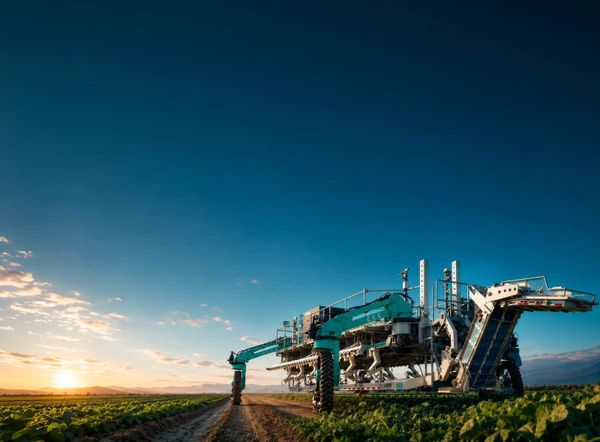
Bernstein's argument is that advances in perception, edge computing and AI now sit on top of a growing stack of off-the-shelf hardware and software, so startups can assemble machines from shared components rather than reinventing every layer. The implication is a compressed path from prototype to commercial deployment. That thesis is plausible and it is exactly the kind of claim that the verification gap exposes. ISO 18497-4:2024 exists precisely because autonomous agricultural machinery needs formal verification methods and validation principles before it is trusted in a field; the 2024 standard set covers design principles, obstacle protection, autonomous operating zones and verification (ISO 18497 series, ISO catalogue). Component assembly may shorten the build, but it does not answer the verification question: whether the assembled machine is dependable under field conditions, in dust, heat and variable light, near people and obstacles.
Reliability is the adoption gate
The recent record of the segment supports the caution. Monarch Tractor's chief executive said in a post-mortem that the technology was sound but that a full-stack hardware, software and service model proved too capital-heavy when funding tightened (AgFunderNews on the Monarch post-mortem). The lesson is not that assembly is wrong; it is that capability alone does not clear the adoption gate. A machine assembled from shared components still has to prove it runs reliably across a season, and that proof is what ISO 18497-4 formalises. The failure mode the component thesis does not address is the one Monarch hit: a stack that is cheap to assemble but expensive to keep dependable at the scale a commercial farm requires.
What it means for South Africa
No South African installed base for Reservoir or its portfolio appears in the available record, and none is claimed here. The relevance is indirect: the funding structure and the Deere announcement are signals about where the field-robotics segment is heading, not evidence of local availability. For a South African operator or investor the concrete watch items are which local integrator or OEM channel would carry rugged-robotics components, and what field-verification evidence to request before any local pilot. The standard to hold a vendor to is not a demonstration video but a documented verification method, of the kind ISO 18497-4 describes, run against local field conditions.